

THAT'S GENERATIVE AI-TOWN,JACK
THE LIST: King Gizzard, Chinatown, Andor, AI Music, and Writing Like Graham Greene

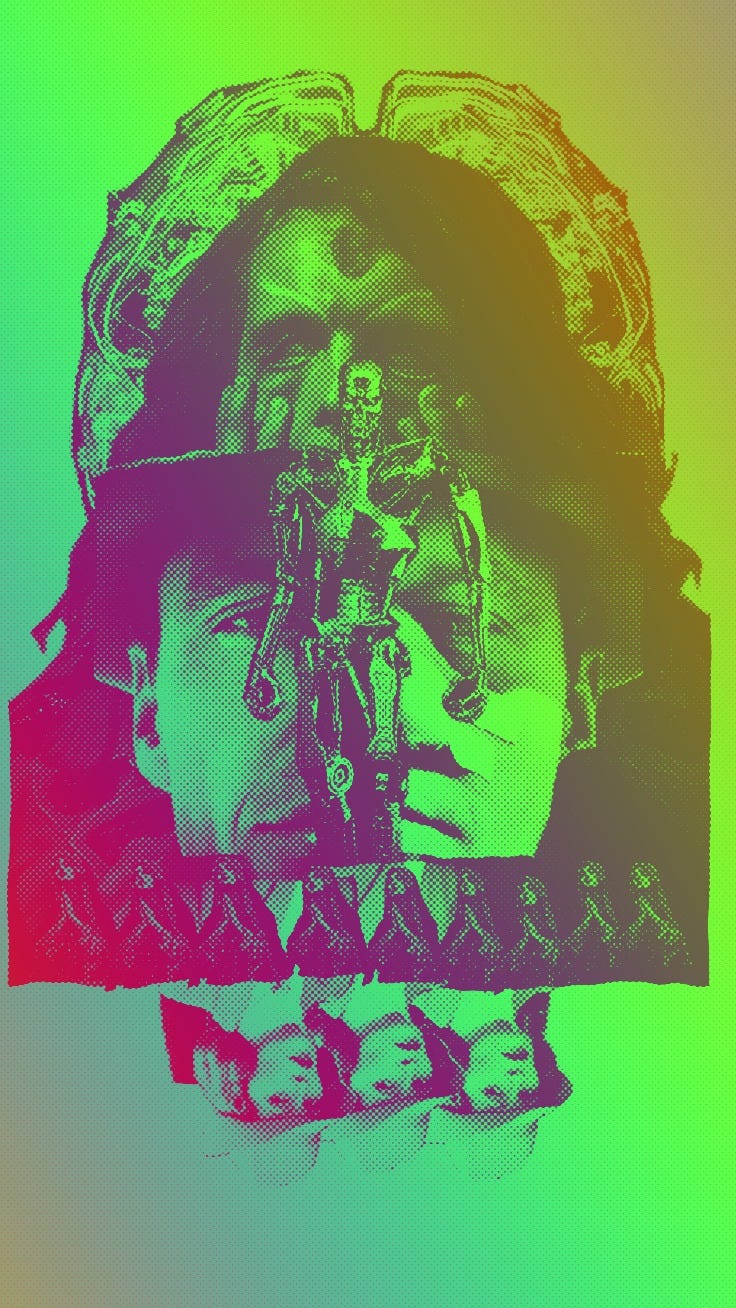
The List is a fortnightly round-up of the music, movies, books, vibes, and oddities. There’s no structure or hierarchy. If you’re new the to list, this is coming to you from crime novelist IAIN RYAN and he says hello.
🤖 A SANE PERSON TALKING TO YOU ABOUT AI
As some of you know, my day job is teaching university music students. Where I work, there’s a campus-wide push to grapple with generative AI. Thus, I have, these last few weeks, found myself teaching a room full of teenagers about this new, weird AI technology—all with an eye to what can be done with it right now.
What follows is a collection of my impressions on AI music so far:
Generative AI is getting a lot better, a lot faster than expected. AI music-making has improved steeply, in ways reminiscent of what we saw with Midjourney and image-making.
The (dramatically) better models are paywalled. Most of what is circulating as AI music is slop, produced by the earlier models.
The reason you probably don’t know all this is because musicians —in the broader sense— aren’t using it. I study musicians, and over the last 20 years, I’ve learned one thing over and over: you don’t know what a technology / instrument / aesthetic / scene is until the musicians get into the mix. The best example: Auto-Tune. First it was was a cheat, then it was the hook in a Cher banger, and then it became the backbone of a certain type of disembodied R&B (à la The Weeknd, Post Malone). What started as anyone can sing, became one of the most sinister sounds in all of pop music.
Gun to my head, I predict these tools will become a meaningful part of music production software in the next 5-10 years. I’m going long because technology adoption tends to be slow in music. To be clear, though, there are already elements of machine learning all over music production and my gut read is that over a long enough time horizon, the upsides of generative AI will simply be too great to ignore...but only when the technology comes to the musicians, not the other way around.
Not using AI will still have a place, but it'll be more like the White Stripes in 2003 vs. Radiohead in 1997. Twenty years later, I’m not sure anyone cares about this historical divide. OK Computer sounds good. Elephant sounds good. Both are classics.
This teaching I’m doing is actually pretty challenging for me. The students can’t see the water they're swimming in—but some days, it’s all I can see: what once took 12 weeks of production software training can now be done in an hour.
None of this music is particularly good (yet), but it never is at the start. The early music I made as a late-teen wasn’t better than what my students can generate with AI after minimal training. No one would say it was. Even me. Generously, you could say it was more human.
But I honestly don’t think that will be enough.
(PS: My thinking on AI and writing fiction can be found here.)
🦎 KING GIZZARD’S ENDLESS DIY SCALING
While I’m talking about my day job: arguably the most successful graduates of the course I teach into are psych-rock band King Gizzard and the Lizard Wizard. They predate me by a year or two (I didn’t teach them), but I’m always curious what they’re up to.
In recent years, the band have started documenting their live shows. From what I’ve read online, they’ve taken an unusual route with this: rather than hiring a production company, they built a team in-house. Watching their recent concerts, it’s clear this has paid off. The films are beautiful—unique, intimate, and clearly what would have passed as commercial-grade not long ago—but freely available on YouTube.
I love it. Is there anything they can’t scale? Yet, in the ‘Gizzverse’ this makes perfect sense. Why can’t the videography be part of the live band, getting better each night, gelling like the jam band they’re filming?
🎬 THAT’S CHINATOWN, FRIENDS
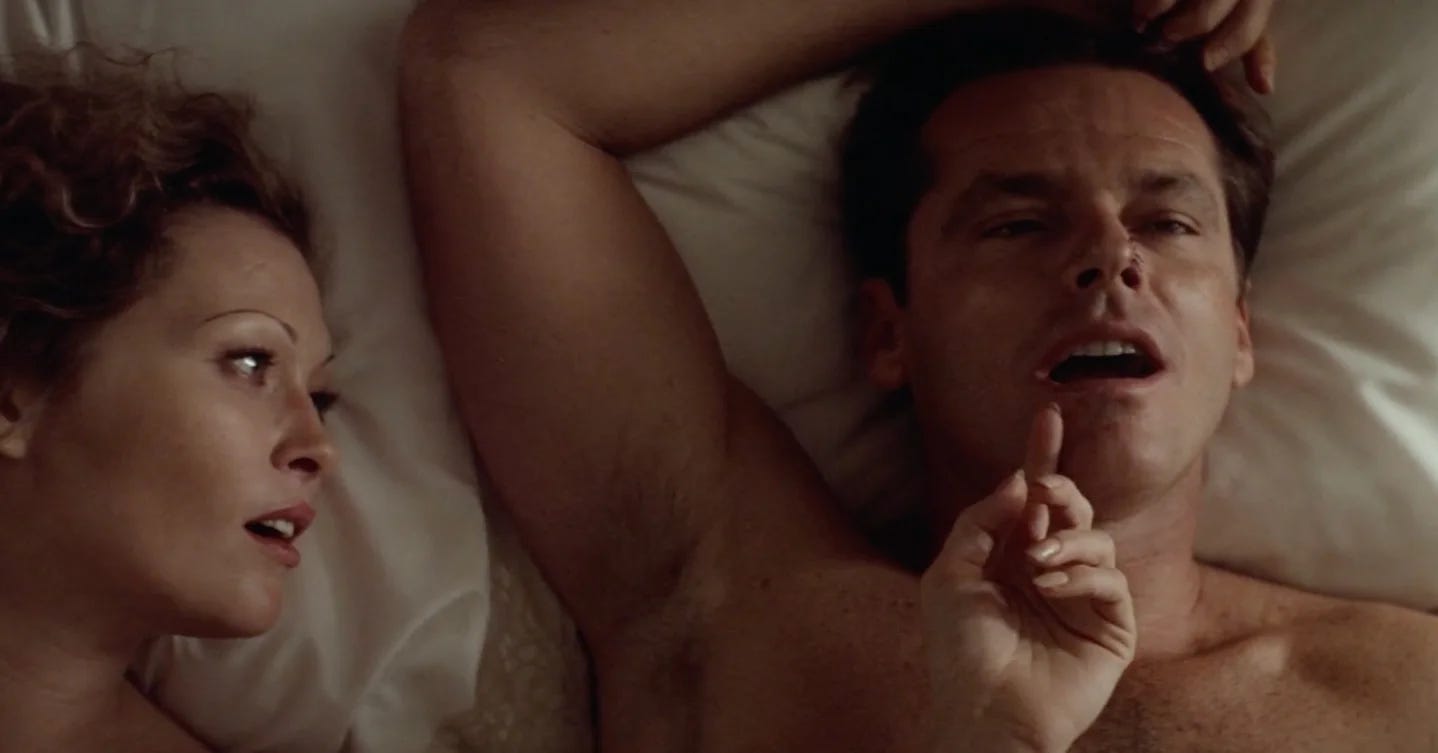
I watched Chinatown again.
On repeat viewing, it stands out thanks to a particularly rare combination: everyone is uniformly excellent, and they’re all in concert with one another. Chinatown is a masterpiece because everyone works at the gaps.
Polanski does his best work when Towne’s script dips, but dials it back when Towne is cooking, or when Nicholson, Dunaway, or Huston are especially fired up. They’re all so solid, and it’s the cohesion that wrecks you. Every moment of this film reeks of doom, right from the start, but we’re never tricked by what we see. We’re warned, over and over, and yet this warning is wrapped up tighit in something so beautiful and strong that it can’t possibly be leading us anywhere too unhinged, right?
Incorrect.
Also watching season 1 of Andor (new to it—had honestly given up on Star Wars, but enjoying this), and the Chris Hammer adaptation Scrublands (pretty solid, tbh).
✍️ GRAHAM GREENE’S 500 WORDS PER DAY
Loved this piece on Graham Greene’s daily writing habits:
Set a low, rigid bar and meet it every day, no matter what the circumstances. The other trick is to read the previous day’s output before sleep, so that the unconscious can do all the legwork. It was that simple:
“Over twenty years I have probably averaged five hundred words a day for five days a week. I can produce a novel in a year, and that allows time for revision and the correction of the typescript. I have always been very methodical, and when my quota of work is done I break off, even in the middle of a scene. Every now and then during the morning’s work I count what I have done and mark off the hundreds on my manuscript. No printer need make a careful cast-off of my work, for there on the front page is marked the figure — 83,764. When I was young not even a love affair would alter my schedule. A love affair had to begin after lunch, and however late I might be in getting to bed — as long as I slept in my own bed — I would read the morning’s work over and sleep on it […] So much of a novelist’s writing, as I have said, takes place in the unconscious; in those depths the last word is written before the first word appears on paper. We remember the details of our story, we do not invent them.”
Read it here:

🧟 DEAD FLAG BLUES (Short Story)

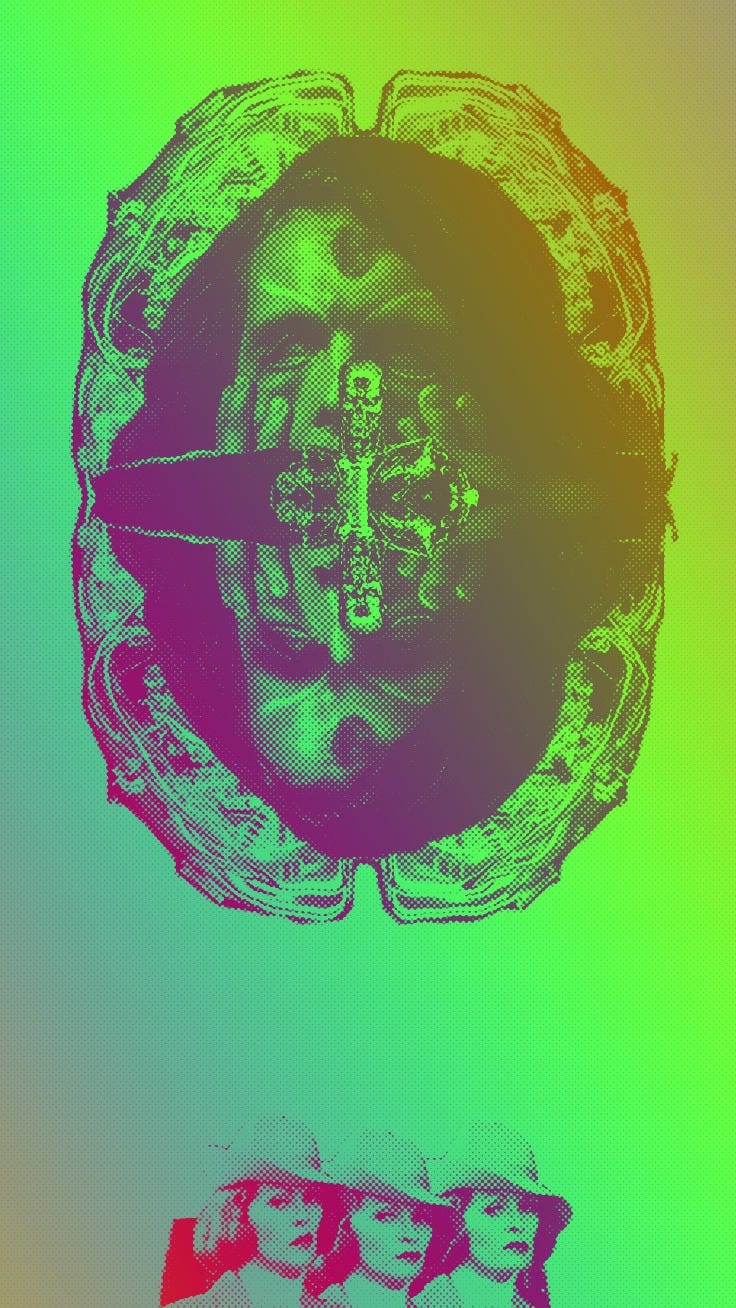
(NB: This artwork isn’t generative AI. It’s collage, using Pinterest, Photoshop and PhotoMosh. Some of the earlier iterations of these were AI, but I like these a little better.)
Read it here.
Churches were havens for the afflicted. People went there to die. There was always a basement or a prayer room inside, with one of those things half-asleep standing up, just waiting for a day like today.
— IAIN
PS: I’m offering some free digital copies of The Strip at the moment (to build this list). The book is included in the following giveaway, alongside a bunch of other titles:

THE END IS HERE 👇
Hi Iain, I was wondering if you would be interested in participating in our research about the future of AI in Creative Industries? Would be really keen to hear your perspectives. It only takes 10mins and I am sure you will find it interesting.
https://form.typeform.com/to/EZlPfCGm